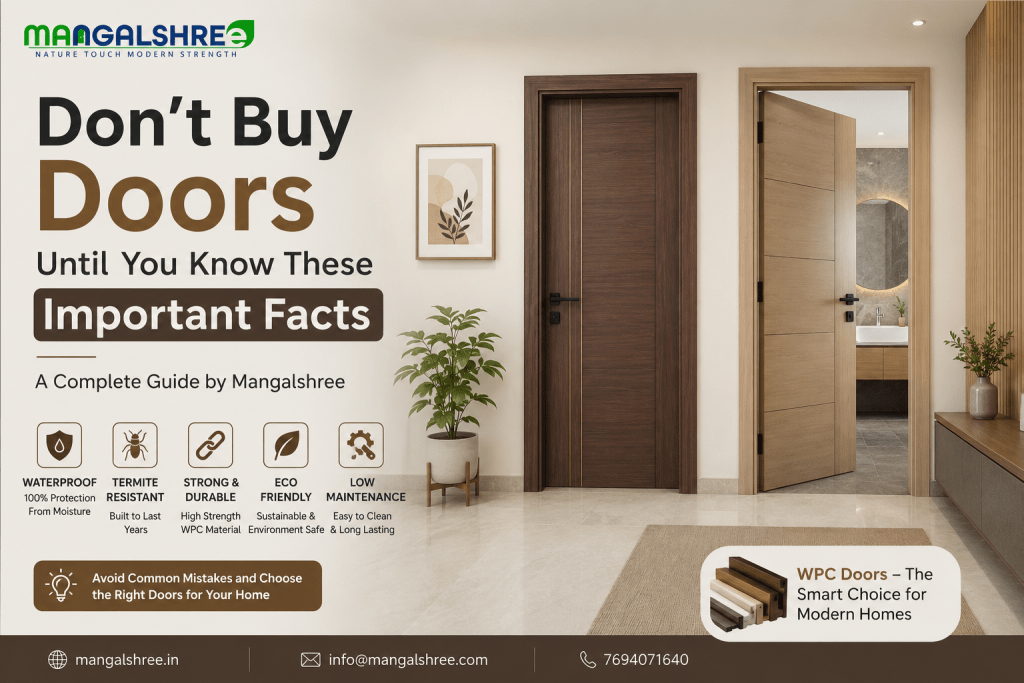
WPC Doors: The Smart Choice for Modern Homes
When building a new home or renovating an existing one, selecting the right doors is one of the most important decisions. While traditional wooden doors have been used for decades, they often suffer from termite attacks, moisture damage, swelling, and high maintenance costs.
This is why WPC Doors have become the preferred choice for homeowners, architects, builders, and interior designers across India.
However, there is one important fact that every buyer should know:
Not every WPC door available in the market offers the same quality.
Many manufacturers sell low-density WPC doors at cheaper prices. These products may look attractive initially but often fail within a short period.
If you’re planning to buy premium quality WPC doors, this detailed buying guide by Mangalshree, a trusted WPC Door Manufacturer in Madhya Pradesh, will help you identify genuine high-density WPC doors and avoid poor-quality products.
What are WPC Doors?
Wood Plastic Composite (WPC) Doors are manufactured using a combination of:
- Wood Powder
- Virgin PVC Polymer
- Additives
- Stabilizers
- Processing Chemicals
This unique combination provides the natural appearance of wood along with the strength and durability of modern polymer technology.
Unlike wooden doors, WPC doors do not absorb moisture and are completely resistant to termites and borers.
Why Are WPC Doors Becoming So Popular?
Today, builders prefer WPC doors because they offer long-lasting performance without regular maintenance.
Major reasons include:
- 100% Waterproof
- Termite Resistant
- Borer Resistant
- Crack Resistant
- Warp Resistant
- Eco-Friendly
- Long Service Life
- Low Maintenance
- Smooth Finish
- Excellent Strength
The Most Important Factor While Buying WPC Doors
Density
If you remember only one thing before purchasing a WPC door, remember this:
Higher Density = Better Quality
Density determines:
- Strength
- Durability
- Screw Holding Capacity
- Load Bearing Capacity
- Lifespan
Many customers compare doors only by price.
Professionals compare them by density.
Understanding WPC Door Density
During manufacturing, foaming technology creates tiny air pockets inside the board.
The amount of air determines whether the board becomes:
Low Density
Contains more air and less material.
Characteristics:
- Lightweight
- Weak
- Soft
- Less durable
- Poor screw holding
Medium Density
Suitable for:
- Furniture
- Cabinets
- Wardrobes
- Interior Panels
High Density
Contains maximum solid material.
Features:
- Heavy
- Strong
- Durable
- Excellent screw grip
- Long-lasting
- Ideal for doors and frames
Standard WPC Density Guide
| Density | Quality | Recommended Use |
|---|---|---|
| 0.40–0.50 g/cm³ | Low Density | Ceiling Panels & Temporary Applications |
| 0.55–0.60 g/cm³ | Medium Density | Wardrobes, Furniture, Interior Partitions |
| 0.65–0.75+ g/cm³ | Premium High Density | WPC Doors, Door Frames, Main Doors, Kitchens |
Problems with Low-Density WPC Doors
Buying cheaper doors may save money today but can lead to expensive repairs later.
Here are the most common issues:
1. Weak Screw Holding
Door hinges and locks rely on strong screw holding.
Low-density boards cannot hold screws properly.
Over time:
- Hinges become loose
- Doors start sagging
- Locks become unstable
2. Door Bending
Poor-quality WPC expands and contracts unevenly.
Result:
- Door warping
- Difficulty in closing
- Misalignment
3. Poor Edge Finish
During cutting:
- Corners chip easily
- Edges break
- Surface becomes rough
Carpenters often struggle to achieve a premium finish.
4. Low Load Capacity
Heavy accessories like:
- Smart Locks
- Door Closers
- Designer Handles
require strong boards.
Low-density doors often fail under additional weight.
5. Short Lifespan
Instead of lasting 20–30 years, cheap WPC doors may require replacement within a few years, increasing long-term costs.
7 Easy Ways to Identify High-Quality WPC Doors
1. Weight Test
Lift two doors.
A premium WPC door should feel noticeably heavier.
If it feels unusually light, it may have low density.
2. Nail Test
Press your thumbnail on an unfinished corner.
Good quality:
✔ Very hard
Poor quality:
✖ Leaves deep marks
3. Core Inspection
Look at the cut section.
Premium boards have:
- Fine texture
- Uniform structure
- No large air bubbles
4. Screw Test
Drive a screw into a sample.
Premium board:
- Tight grip
- Strong hold
Poor board:
- Screw keeps rotating
- Loose fitting
5. Surface Finish
A quality board has:
- Smooth surface
- Uniform color
- No waves
- No visible defects
6. Edge Strength Test
Check whether edges remain intact after cutting.
Good boards produce:
- Clean edges
- No cracking
- No chipping
7. Manufacturer Verification
Always purchase from an experienced manufacturer with:
- Quality testing
- Modern manufacturing facility
- Warranty
- Industry experience
Benefits of Premium High-Density WPC Doors
100% Waterproof
Perfect for:
- Bathrooms
- Kitchens
- Utility Areas
- Coastal Regions
No swelling.
No rotting.
No moisture damage.
Complete Termite Protection
Unlike wood,
WPC doors are:
- Termite Proof
- Borer Proof
- Pest Resistant
No chemical treatment required.
Fire Resistant
Premium WPC doors offer improved fire-retardant properties and help slow flame spread compared to untreated wood.
Eco-Friendly
WPC doors help reduce the use of natural timber.
Benefits include:
- Less tree cutting
- Recyclable material
- Sustainable construction
Low Maintenance
Forget about:
- Painting
- Polishing
- Anti-termite treatment
Simply clean with a damp cloth.
Excellent Durability
Premium WPC doors maintain their appearance for years with minimal maintenance.
Where Can WPC Doors Be Installed?
Premium WPC doors are suitable for:
- Residential Homes
- Apartments
- Villas
- Offices
- Hotels
- Hospitals
- Schools
- Colleges
- Restaurants
- Shopping Malls
- Commercial Buildings
- Industrial Projects
Why Choose Mangalshree?
At Mangalshree, quality is our highest priority.
As a leading WPC Door Manufacturer in Madhya Pradesh, we manufacture premium-quality WPC doors and door frames using advanced production technology and strict quality standards.
Why Customers Trust Mangalshree
- High-Density WPC Doors
- Premium Raw Materials
- Superior Screw Holding Capacity
- Waterproof Technology
- Termite & Borer Resistant
- Modern Manufacturing Facility
- Precision Finishing
- Multiple Designs & Sizes
- Competitive Pricing
- Bulk Supply Across India
Whether you’re building a home, hotel, office, or commercial project, Mangalshree delivers durable WPC solutions designed for long-term performance.
Frequently Asked Questions (FAQs)
Are WPC doors better than wooden doors?
Yes. WPC doors offer better resistance to water, termites, and weather while requiring much less maintenance.
How can I identify a high-density WPC door?
Check the weight, screw-holding capacity, edge quality, surface finish, and core structure. High-density boards are heavier, stronger, and more durable.
Are WPC doors suitable for bathrooms?
Absolutely. WPC doors are 100% waterproof, making them ideal for bathrooms, kitchens, and other moisture-prone areas.
Do WPC doors require painting?
No. Premium WPC doors come with a finished surface and require minimal maintenance.
Can WPC doors support smart locks?
Yes. High-density WPC doors provide excellent screw-holding strength, making them suitable for smart locks and premium hardware.
Final Thoughts
Choosing the right WPC door is not just about appearance—it is about strength, density, durability, and long-term value. Low-density doors may seem affordable initially, but they often lead to higher maintenance and replacement costs over time.
If you’re looking for reliable, high-density WPC doors that deliver lasting performance, choose Mangalshree, a trusted WPC Door Manufacturer in Madhya Pradesh. Our products are engineered for superior strength, waterproof performance, termite resistance, and elegant design, making them an ideal choice for modern residential and commercial projects.