Introduction
Choosing the right door is an important decision for any residential, commercial, or institutional project. A door needs to look attractive, remain stable with regular use, and perform well in the environment where it is installed. Traditional wooden doors have been widely used for years, but concerns related to moisture, termites, maintenance, warping, and long-term durability have encouraged buyers to explore modern alternatives.
One such alternative is WPC (Wood Plastic Composite).
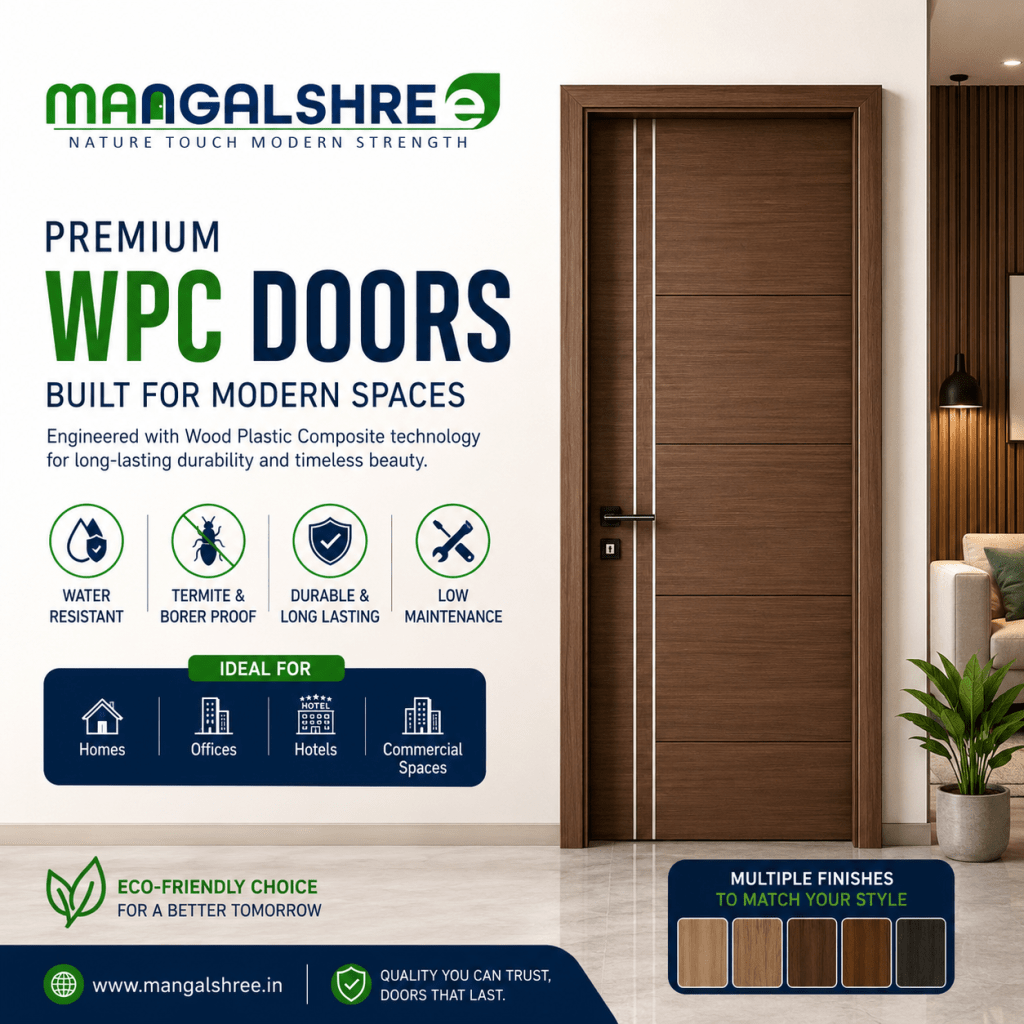
WPC doors combine wood-based material with polymer technology to create an engineered door solution designed for modern construction requirements. They can offer a practical combination of durability, moisture resistance, low maintenance, design flexibility, and consistent performance.
For customers searching for a WPC Door Manufacturer in Madhya Pradesh, understanding the material, manufacturing process, quality factors, applications, and purchasing considerations is important before placing an order.
This guide explains what WPC doors are, how they are manufactured, where they can be used, what benefits they offer, and how to select the right product for your project.
What Are WPC Doors?
WPC stands for Wood Plastic Composite. Instead of being made from a single piece of natural timber, WPC products are manufactured by combining wood-based material with polymers and other carefully selected components.
The resulting composite material can be processed into door panels, frames, profiles, and other construction products.
What Makes WPC Different From Traditional Wood?
Natural wood has its own characteristics, including grain, moisture content, density, and natural variations. These characteristics can vary from one piece of timber to another.
WPC is an engineered material. Its manufacturing process allows manufacturers to control the composition and production conditions more closely.
This can provide advantages such as:
- Consistent dimensions
- Improved moisture resistance
- Termite and borer resistance
- Lower maintenance requirements
- Easy machining
- Multiple design possibilities
- Consistent surface appearance
The exact performance of a WPC door depends on the material formulation, manufacturing quality, density, finishing, installation, and intended application.
How Are WPC Doors Manufactured?
The quality of a finished WPC door is influenced by every stage of its manufacturing process. A good manufacturing system focuses on material preparation, controlled processing, accurate machining, finishing, and quality inspection.
Raw Material Selection
The process begins with the selection of suitable raw materials.
Depending on the product formulation, manufacturers may use:
- Wood-based fibres or flour
- Polymer components
- Mineral fillers
- Stabilising additives
- Processing aids
- Colour pigments
The composition of these materials affects the characteristics of the finished product.
Why Raw Material Quality Matters
Poor or inconsistent raw materials can affect density, surface quality, dimensional stability, and machining performance.
For this reason, material inspection should be considered an important part of WPC production rather than an optional step.
Material Preparation and Mixing
The selected components are prepared and mixed according to a controlled formulation.
Uniform mixing helps distribute the different components throughout the material. Consistency at this stage can contribute to more predictable properties in the finished WPC profile.
Extrusion
Extrusion is a key stage in the manufacturing process.
The prepared material is processed under controlled temperature and pressure conditions and formed into the required profile.
The process needs to be carefully controlled because variations in temperature, material flow, pressure, or formulation can influence the final characteristics of the product.
Cooling and Calibration
After extrusion, the hot profile needs to be cooled and stabilised.
Calibration helps maintain the required dimensions and profile geometry.
Proper calibration can help achieve:
- Consistent thickness
- Accurate width
- Better straightness
- Uniform profile dimensions
Dimensional accuracy is especially important for door applications because the door needs to work correctly with its frame and hardware.
Cutting and Machining
Once the profile has stabilised, it can be cut and machined according to the required design.
Depending on the door specification, machining may include:
- Hinge locations
- Lock pockets
- Handle openings
- Decorative grooves
- Panel details
- Custom designs
Modern machining equipment can help manufacturers achieve repeatable results for multiple doors with similar specifications.
Surface Finishing
The appearance of a door is an important part of interior design.
WPC doors can be produced with different finishes, textures, colours, and decorative appearances.
Depending on the product, options may include wood-inspired finishes, contemporary colours, textured surfaces, or decorative laminates.
Quality Inspection
Before dispatch, finished products should be checked for important characteristics.
Quality inspection may consider:
- Dimensions
- Straightness
- Surface finish
- Colour consistency
- Edge quality
- Machining accuracy
- Hardware compatibility
- Overall appearance
A systematic quality process helps reduce variations and provides greater consistency between products.
Major Benefits of WPC Doors
WPC doors have become increasingly popular because they address several practical requirements associated with modern construction.
Moisture Resistance
Moisture can be a significant concern for conventional wood products.
WPC doors are designed with polymer components that can provide improved resistance to moisture compared with many untreated wooden materials.
Termite and Borer Resistance
This makes them suitable for applications where humidity or occasional moisture exposure needs to be considered.
Termite damage can create serious problems for wooden products.
WPC doors are commonly selected by customers looking for a material with resistance to termite and borer-related damage.
However, buyers should always verify the specific performance claims and product specifications provided by the manufacturer.
Low Maintenance
Another advantage of WPC is its relatively simple maintenance.
Regular care generally involves:
- Removing dust
- Cleaning the surface
- Checking hardware
- Keeping hinges properly maintained
- Following the manufacturer’s cleaning recommendations
This can make WPC an attractive option for busy residential and commercial environments.
Dimensional Stability
Environmental changes can affect natural timber.
Engineered WPC products are manufactured under controlled conditions, which can help provide greater dimensional consistency.
This characteristic can be particularly useful for projects where multiple doors need to maintain consistent dimensions.
Design Flexibility
WPC doors are available in different styles and finishes.
Customers can select designs according to:
- Interior theme
- Room type
- Colour scheme
- Architectural style
- Project requirements
This allows WPC doors to combine functional requirements with modern interior aesthetics.
Where Can WPC Doors Be Used?
One of the strengths of WPC doors is their versatility.
They can be considered for a wide range of residential and commercial applications.
Residential Applications
WPC doors can be used in:
- Bedrooms
- Bathrooms
- Kitchens
- Utility rooms
- Apartments
- Villas
- Modern homes
Bathrooms and utility areas can particularly benefit from materials with improved moisture resistance.
Commercial Applications
Commercial projects often require doors that can handle frequent usage while remaining easy to maintain.
Potential applications include:
- Offices
- Retail stores
- Hotels
- Restaurants
- Commercial buildings
- Business spaces
Institutional Applications
WPC doors can also be considered for institutional projects where durability and maintenance are important.
These may include:
- Schools
- Colleges
- Hospitals
- Healthcare facilities
- Government buildings
- Other institutional projects
The final product specification should always be selected according to the environment and expected usage.
WPC Door Frames: Why They Matter
A door does not work independently.
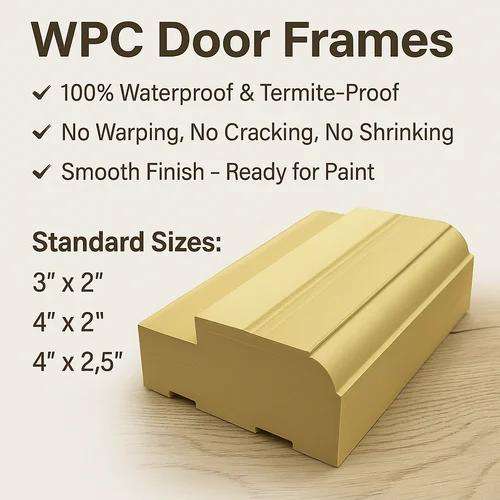
The frame plays an important role in installation, alignment, hardware positioning, and overall performance.
Benefits of Using a Compatible WPC Frame
A suitable WPC door frame can provide:
- Dimensional consistency
- Moisture resistance
- Compatibility with WPC doors
- Easy machining
- Cleaner installation
- A coordinated appearance
When purchasing a door, it is therefore useful to consider the door and frame as one complete system rather than treating them as completely separate products.
WPC Doors vs Wooden Doors
Both WPC and wooden doors have their own applications.
The right choice depends on the project requirements.
| Feature | WPC Doors | Wooden Doors |
|---|---|---|
| Moisture Resistance | High | Depends on wood and treatment |
| Termite Resistance | High | Requires suitable protection |
| Maintenance | Generally Low | Can be Higher |
| Dimensional Consistency | High | Can vary with environment |
| Appearance | Wood-inspired and modern | Natural timber appearance |
| Design Options | Multiple | Multiple |
| Machining | Suitable for standard applications | Widely machinable |
| Applications | Residential & Commercial | Residential & Premium Interiors |
The goal should not be to select a material simply because it is popular. Instead, choose according to the location, expected usage, maintenance requirements, budget, and design expectations.
How to Choose the Right WPC Door
Buying a WPC door based only on appearance or price can result in an unsuitable choice.
Before purchasing, consider the following factors.
Check the Product Density
Density can influence the strength, weight, machining performance, and screw-holding capability of a WPC product.
Ask the manufacturer for relevant technical information before making a bulk purchase.
Check the Door Thickness
Different applications may require different thicknesses.
Consider whether the door is intended for:
- Bedroom use
- Bathroom use
- Commercial spaces
- High-traffic areas
- Institutional projects
The selected thickness should be compatible with the intended hardware and installation method.
Examine the Surface Finish
Always inspect the finish carefully.
Look for:
- Consistent colour
- Smooth surface
- Proper edges
- Uniform texture
- Good lamination
- Absence of visible manufacturing defects
Check Hardware Compatibility
The door needs to work properly with its hardware.
Consider compatibility with:
- Hinges
- Locks
- Handles
- Door closers
- Other accessories
Evaluate the Manufacturer
A reliable manufacturer should be able to explain product specifications, available designs, manufacturing capabilities, and project requirements clearly.
For bulk projects, also consider production capacity and order coordination.
Why Choose Mangalshree for WPC Doors?
Mangalshree focuses on providing WPC door and door-frame solutions for modern residential and commercial requirements.
Customers looking for a WPC Door Manufacturer in Madhya Pradesh should consider factors beyond the initial product price. Manufacturing consistency, product specifications, finish quality, availability, project requirements, and customer support can all influence the overall value of a door system.
Mangalshree’s WPC solutions are designed around practical requirements such as:
- Moisture resistance
- Termite and borer resistance
- Low maintenance
- Modern appearance
- Easy installation
- Long-term usability
Whether the requirement is for a home, apartment, office, hotel, institutional building, or bulk construction project, the right product should be selected according to the specific application.
What Makes a Manufacturer Important?
The manufacturing process influences the quality of the final product.
A professional WPC Door Manufacturer in Madhya Pradesh should focus on consistent production, suitable raw materials, controlled processing, accurate dimensions, quality finishing, and reliable product support.
This is especially important for large projects where dozens or hundreds of doors may be required.
WPC Door Buying Checklist
Before placing an order, buyers can use the following checklist:
Product Quality
- Check material specifications.
- Ask about product density.
- Examine the surface finish.
- Check dimensional consistency.
- Confirm the required thickness.
Door & Frame
- Check frame compatibility.
- Confirm hinge and lock requirements.
- Verify installation specifications.
- Check whether custom sizes are available.
Supplier
- Evaluate manufacturing capability.
- Ask about bulk-order capacity.
- Confirm available finishes and designs.
- Discuss delivery requirements.
- Ask about product support and warranty terms where applicable.
Using a structured buying process can help avoid problems later.
Common Mistakes to Avoid When Buying WPC Doors
Choosing Only on Price
The cheapest product is not necessarily the most economical choice.
Material quality, density, manufacturing consistency, finish, and service can all affect long-term value.
Ignoring the Frame
A door with a poor or incompatible frame can create installation and alignment problems.
Not Checking Specifications
Always ask for technical information instead of relying only on photographs or verbal claims.
Selecting the Wrong Thickness
The required thickness depends on the application, hardware, and project requirements.
Ignoring Installation
Even a good-quality door may not perform correctly if it is installed improperly.
Professional installation and correct hardware selection are important parts of the overall door system.
Frequently Asked Questions About WPC Doors
Are WPC doors suitable for bathrooms?
Yes, WPC doors are commonly considered for bathrooms because of their moisture-resistant characteristics. The exact suitability should be checked against the manufacturer’s product specifications.
Are WPC doors termite resistant?
WPC doors are generally selected for their resistance to termite and borer-related damage. Buyers should confirm the specific product specifications before purchasing.
Do WPC doors need regular painting?
Many WPC doors are supplied with finished surfaces, meaning regular painting may not be required. The appropriate care depends on the specific finish.
Are WPC doors suitable for commercial buildings?
Yes. They can be used in offices, hotels, retail spaces, institutions, and other commercial applications when the product specification matches the intended usage.
Can WPC doors be customised?
Depending on the manufacturing system, WPC doors can be available in different sizes, finishes, colours, patterns, and machining configurations.
Are WPC doors completely maintenance-free?
No material should be considered completely maintenance-free. WPC generally requires relatively simple routine cleaning and periodic hardware inspection.
How long can WPC doors last?
Service life depends on product quality, installation, usage, environment, and maintenance. Buyers should discuss expected service life and warranty terms directly with the manufacturer.
Why WPC Is Becoming a Popular Door Material
Construction requirements are changing.
Customers increasingly want products that combine:
- Durability
- Modern appearance
- Easy maintenance
- Moisture resistance
- Design flexibility
- Consistent quality
WPC addresses many of these requirements through engineered material technology.
As manufacturing processes continue to improve, WPC products are likely to remain relevant across residential, commercial, hospitality, healthcare, and institutional construction.
For buyers, the important point is to focus on product quality rather than simply the WPC label.
Different manufacturers can use different formulations, production processes, quality controls, and finishing systems. Therefore, comparing technical specifications and manufacturing standards is essential.
Conclusion
WPC doors offer a modern alternative to conventional wooden doors for customers looking for a combination of functionality, design flexibility, moisture resistance, and relatively low maintenance.
From raw material selection and controlled mixing to extrusion, calibration, machining, finishing, and quality inspection, the manufacturing process plays a major role in determining the final product’s performance.
For homeowners, architects, builders, contractors, interior designers, and commercial developers, selecting the right manufacturer is just as important as selecting the right door design.
If you are searching for a WPC Door Manufacturer in Madhya Pradesh, Mangalshree provides WPC door and door-frame solutions designed for modern residential, commercial, and project requirements.
Explore the WPC door solutions available at mangalshree.in and choose a product based on your project’s requirements, design preferences, and performance expectations.